
Why I believe BCS should be the professional qualification of choice for UK data protection practitioners, and why we must rethink how we develop professional competence in an age of artificial intelligence.
Having spent over 30 years working across information security, information governance, and data protection, and having played a leadership role in developing data protection and AI practice in the United Kingdom, I believe it is time for our profession to reconsider its approach to professional education.
As the founder and Executive Chair of Data Privacy Advisory Service (DPAS®), author of Mastering AI: A Guide for Data Protection Practitioners, a Fellow of the British Computer Society, a member of the Institute of Association of Privacy Professionals and someone who has delivered both BCS and IAPP professional qualifications, my feet are certainly in both camps. I have developed some strong views on what constitutes effective professional education.
My academic qualifications, including an LLM in Information Rights Law and Practice and a Postgraduate Certificate in Higher Education, alongside three decades of practical experience, inform those views.
For me, professional education has always been about developing practitioners, not simply preparing people to pass examinations.
Brexit changed the educational landscape
For several years following Brexit, the similarities between the UK GDPR and EU GDPR meant that the distinction between UK and European professional qualifications was perhaps less significant than it is today.
The Data (Use and Access) Act 2025 (DUAA) has changed that conversation.
Whilst the two legislative frameworks retain common foundations, the United Kingdom is progressively developing its own regulatory identity. Changes to recognised legitimate interests, automated decision-making, subject access requests, international transfers and electronic communications are increasingly relevant to the everyday work of UK practitioners.
We also operate within a distinct judicial and regulatory environment, with domestic statutory exemptions, developing case law and regulatory interpretation.
A practitioner advising a UK organisation needs to understand these complexities. Knowledge of the EU GDPR, however comprehensive, is no longer sufficient in isolation.
This raises a legitimate question for employers, recruitment professionals and those entering the profession: why would we automatically prioritise a European-focused qualification over one specifically designed around the legislative environment in which the individual will practise?
BCS versus IAPP CIPP/E: a question of relevance
I have considerable respect for the IAPP and its contribution to the international development of the privacy profession. Having delivered CIPP/E training myself, I recognise its strengths, particularly for practitioners advising multinational organisations and those operating across European jurisdictions.
However, international recognition and domestic relevance are not necessarily the same thing.
The IAPP Certified Information Privacy Professional/Europe (CIPP/E) is principally designed around European data protection law, the EU GDPR, European institutions and associated regulatory frameworks.
By comparison, the BCS Practitioner Certificate in Data Protection provides a much more explicit focus on the UK legislative environment while retaining an understanding of European data protection law.
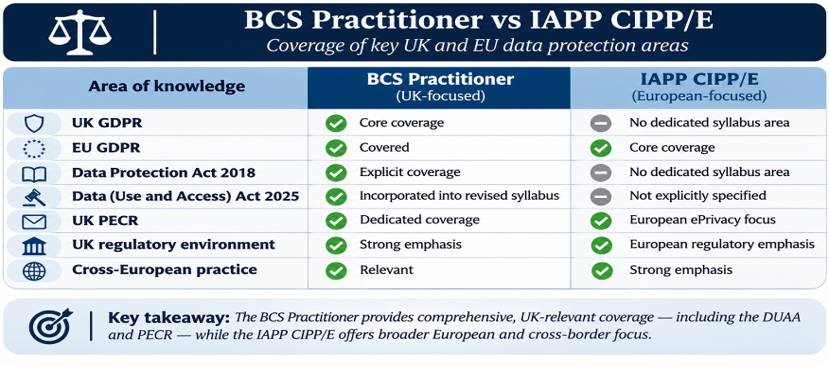
For professionals working within the NHS, local government, education, charities and the wider UK commercial sector, I believe BCS provides the more relevant primary professional qualification.
That is not a criticism of the IAPP. It is a recognition that qualifications should be selected according to the professional environment in which they will be applied.
PECR: the legislation we cannot afford to overlook
One of my longstanding concerns is how often UK data protection practitioners misunderstand or underestimate the importance of the Privacy and Electronic Communications Regulations 2003 (PECR).
Establishing a lawful basis under the UK GDPR does not automatically provide an organisation with permission to undertake electronic direct marketing or deploy tracking technologies.
Understanding the relationship between PECR, the UK GDPR and the amendments introduced by the DUAA is fundamental to providing competent professional advice.
The BCS syllabus explicitly addresses UK PECR. Whilst CIPP/E covers the European ePrivacy Directive and associated considerations, this is not equivalent to understanding the detailed requirements of contemporary UK electronic communications legislation.
For UK organisations seeking advice on digital marketing, cookies, customer acquisition and technological innovation, that distinction has considerable commercial and regulatory significance.
Developing a professional pathway, not simply selling qualifications
Some years ago, I designed a professional development pathway for aspiring and existing Data Protection Officers. It was based on a relatively simple proposition: understanding data protection law is an essential foundation, but it does not, in itself, make someone an effective DPO.
The pathway comprised three progressive stages:
Stage one: BCS Foundation Certificate in Data Protection
Developing an understanding of the fundamental principles of data protection law, regulatory requirements, individual rights and organisational responsibilities.
Stage two: BCS Practitioner Certificate in Data Protection
Building upon that foundation to develop a more detailed understanding of legislation, its interpretation and its application within organisational environments.
Stage three: The Effective DPO
A two-day professional development programme that I designed to bridge the gap between legal knowledge and professional practice.
The Effective DPO was deliberately different. It was not intended to be another examination-based qualification. Its purpose was to equip practitioners with the practical tools, techniques and professional skills necessary to operate effectively within their organisations.
This included developing the ability to influence senior leaders, establish governance arrangements, communicate risk, challenge organisational decisions, prioritise workloads and demonstrate the effectiveness of the DPO function.
Importantly, it also encouraged practitioners to take ownership of their continuing professional development, identify gaps in their own knowledge and develop a sustainable approach to professional learning.
Once practitioners had acquired the fundamentals of data protection law and regulatory guidance, the next challenge was to develop the confidence and capability to apply that knowledge independently.
That was the purpose of the pathway, and it remains as relevant today as when I first designed it.
Bloom’s taxonomy and the development of professional competence
My background in higher education has influenced how I approach professional development.
Bloom’s taxonomy, originally developed in 1956 and subsequently revised by Anderson and Krathwohl in 2001, identifies six levels of cognitive learning: remembering, understanding, applying, analysing, evaluating and creating.
The distinction between these levels is particularly important when developing Data Protection Officers.
Recalling the provisions of Article 15 of the UK GDPR is fundamentally different from evaluating a complex subject access request involving competing rights, statutory exemptions, and legal professional privilege.
Similarly, knowing when a Data Protection Impact Assessment is required differs from being able to undertake one, challenge organisational assumptions, and recommend proportionate mitigations.
My original professional development pathway broadly reflected this progression.
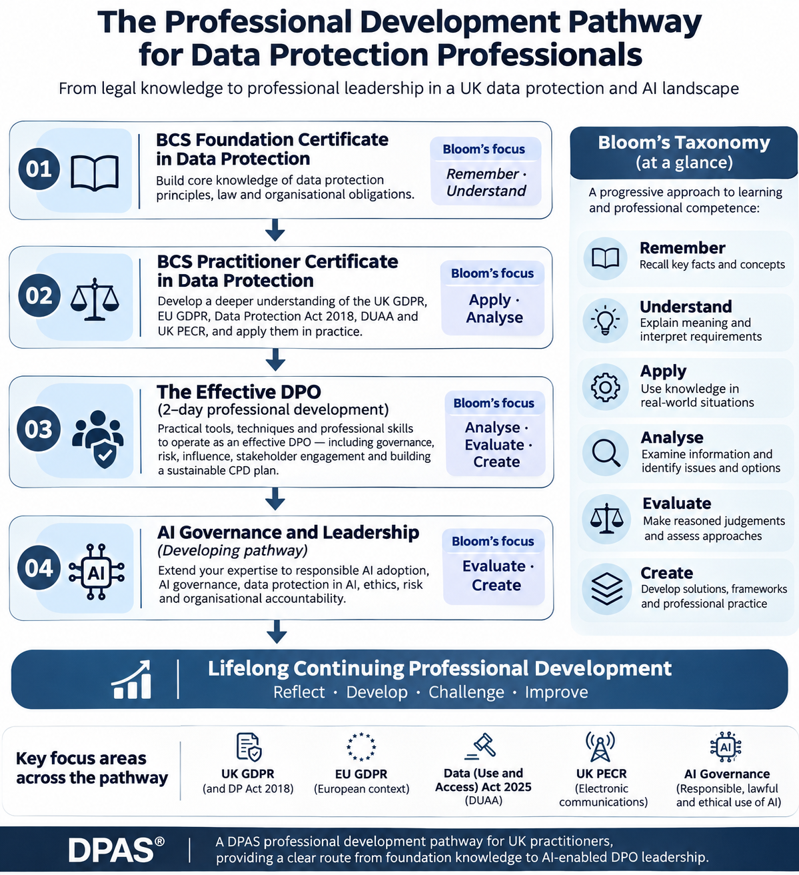
This represents my educational interpretation of the pathway rather than a formal benchmarking exercise.
Both BCS and IAPP qualifications provide valuable foundations in knowledge, understanding and application. Both also rely on multiple-choice examinations, which, when appropriately designed, can assess elements of higher-order thinking.
However, there are limits to what can be demonstrated by selecting an answer from a predetermined set of options.
Neither examination directly requires candidates to conduct a data protection audit, construct a comprehensive DPIA, produce a legally reasoned response to a complex subject access request or defend their professional advice before a board of directors.
These are precisely the professional capabilities we should seek to develop through complementary learning and authentic assessment.
Artificial intelligence changes everything
When I wrote Mastering AI: A Guide for Data Protection Practitioners, one of my objectives was to encourage the profession to move beyond viewing artificial intelligence simply as another compliance challenge.
AI is fundamentally changing how organisations operate, make decisions and create value. It is also changing the nature of professional expertise.
Artificial intelligence can already retrieve legislation, summarise regulatory guidance, draft policies and assist with the analysis of complex information.
What it cannot do on behalf of a practitioner is assume their professional accountability.
The value of the data protection professional will increasingly reside in their ability to critically evaluate information, challenge its accuracy, understand organisational context and exercise sound professional judgement.
These capabilities sit towards the higher levels of Bloom’s taxonomy.
For this reason, I believe professional education must evolve beyond the acquisition and reproduction of legal knowledge.
The next generation of Data Protection Officers will need to understand not only data protection legislation but also AI governance, responsible innovation, algorithmic accountability, organisational risk and the ethical implications of emerging technologies.
Redesigning the professional pathway for the AI era
I am now working with colleagues at DPAS to redesign and further develop the professional pathway I originally created, embracing the opportunities and challenges presented by artificial intelligence.
The objective is to retain the academic and legal foundations provided by BCS whilst developing a broader set of professional capabilities that reflect the changing responsibilities of Data Protection Officers.
I see specialist programmes from the Institute of IT as an important complement to this. In my view, BCS qualifications and appropriate Institute of AI programmes should increasingly become go-to choices for UK practitioners seeking to develop expertise across data protection and artificial intelligence.
The ambition is to develop a progressive educational pathway that takes individuals from foundational legal knowledge through to advanced professional practice, AI governance and independent continuing professional development.
I do not believe every DPO needs to become a data scientist or an AI engineer. However, I firmly believe that every DPO will increasingly need to understand how artificial intelligence is developed, deployed, governed and used within their organisation.
Data protection and AI governance can no longer sensibly be treated as entirely separate disciplines.
Why DPAS is concentrating on BCS
At DPAS, we have made a considered strategic decision to focus our professional education offering on BCS qualifications and develop specialist UK-focused data protection and AI expertise. In addition to our bespoke offerings such as Subject Access Requests, Data Ethics, et al.
Having delivered both BCS and IAPP qualifications, we base this decision on our experience educating practitioners, advising organisations, and understanding the evolving requirements of the UK market.
Our ambition is to establish DPAS as a Centre of Excellence for BCS professional qualifications and practitioner development, bringing together academic rigour, specialist legal knowledge, contemporary educational practice and real-world professional experience.
Our objective is not simply to sell training courses or prepare delegates to pass examinations. It is to create a coherent professional development pathway that supports practitioners throughout their careers. This is important and unique to us.
This is a commercial decision, and I make no apology for being transparent about that. As the founder of a business operating within this market, I have a professional and commercial interest in the success of that approach.
Nevertheless, the decision is grounded in my assessment of the legislative landscape, educational requirements and the practical challenges facing UK data protection professionals.
I believe there is a significant opportunity to raise standards across the profession by bringing together recognised qualifications, practical professional development, AI education and continuing professional learning.
A challenge to UK employers and recruiters
Article 37(5) of the UK GDPR requires Data Protection Officers to be designated on the basis of their professional qualities, expert knowledge of data protection law and practices, and their ability to fulfil their statutory responsibilities.
It does not prescribe a particular professional qualification.
Yet I continue to see recruitment advertisements prioritising internationally recognised certifications without necessarily considering their relevance to UK law or their ability to evidence practical professional competence.
I would encourage employers to reconsider how they specify professional qualifications, particularly in light of the DUAA and the increasing divergence between UK and European legislation.
For practitioners operating predominantly within the United Kingdom, I recommend developing a strong legal foundation through BCS, building practical professional capabilities, and complementing that expertise with specialist education in artificial intelligence.
CIPP/E remains a valuable qualification for those requiring European and international expertise, but it should not automatically be considered the default qualification for UK data protection practitioners.
The future of our profession
After three decades in this profession, I remain passionate about raising professional standards and developing the next generation of data protection and AI leaders.
I believe BCS, as the Chartered Institute for IT, is particularly well positioned to support that ambition. Complemented by specialist AI education and practical professional development, it provides the foundations for a more comprehensive approach to developing UK practitioners.
At DPAS, we have chosen to invest our expertise and educational resources in that direction.
Ultimately, I want practitioners to leave our programmes with considerably more than a certificate. I want them to return to their organisations with the confidence to challenge decisions, the tools to drive change, the intellectual curiosity to keep learning, and the professional competence to make a meaningful difference.
Qualifications should demonstrate what we know. Professional development should demonstrate what we can do. The future of our profession depends upon understanding the difference.
Nigel Gooding LLM, FBCS, FCMI
Founder and Executive Chair of Data Privacy Advisory Service (DPAS®), author of Mastering AI: A Guide for Data Protection Practitioners, academic, educator and practitioner with over 30 years of experience across information security, information governance and data protection. Holder of an LLM in Information Rights Law and Practice and a Postgraduate Certificate in Higher Education.
References:
Anderson, L.W. and Krathwohl, D.R. (eds.) (2001) A Taxonomy for Learning, Teaching, and Assessing: A Revision of Bloom’s Taxonomy of Educational Objectives. New York: Longman.
BCS (2026) Practitioner Certificate in Data Protection: Syllabus v9.9.
Bloom, B.S. et al. (1956) Taxonomy of Educational Objectives: Handbook I: Cognitive Domain. New York: David McKay.
IAPP, CIPP/E Body of Knowledge and Examination Blueprint.
Data (Use and Access) Act 2025.
Data Protection Act 2018.
Privacy and Electronic Communications (EC Directive) Regulations 2003.
UK General Data Protection Regulation, Article 37.
#BCS #DataProtection #ArtificialIntelligence #AIGovernance #UKGDPR #DUAA #DPO #ProfessionalDevelopment #Leadership #DPAS
Get in touch today!
If you’re planning a new project, introducing AI or reviewing an existing system, DPAS can provide data protection consultancy and AI governance support to help you understand your responsibilities and take a considered approach to risk.